
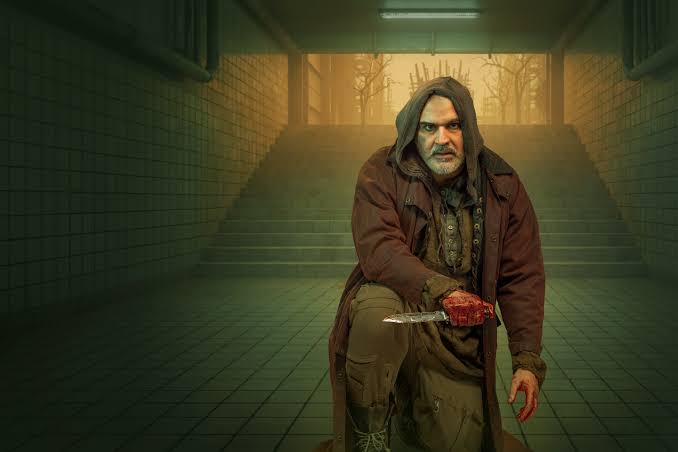
Bard on the Beach’s production of Macbeth shows just how well Shakespeare’s tragedy can adapt to different settings. Reimagined in a dystopian post-apocalyptic world, the production highlights how naturally the play’s themes of ambition, violence, paranoia, and collapsing social order fit into a landscape where civilization itself feels unstable.
On paper, moving Macbeth from medieval Scotland into a world after societal collapse could feel like a risk. In practice, it works surprisingly well. In a setting where institutions have fallen away and power belongs to whoever is willing to take it, Macbeth’s rise and fall feels immediate and believable in a different way.
The BMO Mainstage is used effectively to create a world that feels both wide open and stripped down. The staging makes good use of the space without ever feeling cluttered, and it keeps the action moving while still reinforcing the sense of a fractured world constantly on edge.
One of the more interesting choices is the reimagining of the witches. Rather than traditional supernatural figures, they appear as mysterious “figures” who seem to belong to this broken world. It’s a shift that changes how the prophecies land. They feel less like magic and more like something ambiguous—possibly fate, possibly manipulation, or possibly just interpretation.
Munish Sharma anchors the production as Macbeth, moving convincingly from respected warrior to increasingly isolated and paranoid ruler. The descent feels steady and grounded, which makes it all the more unsettling as it progresses.
Tess Degenstein is particularly strong as Lady Macbeth. What stands out is the clarity of her arc, from controlled determination early on to a slow, convincing unraveling into guilt and madness. It never feels sudden; instead, it builds in a way that feels inevitable but still difficult to watch.
Sebastian Kroon brings a quiet steadiness to Banquo, which makes his presence feel important even before his fate becomes clear. He provides a grounded contrast to Macbeth’s increasing instability.
Jacob Leonard stands out in the second half as Macduff. His grief after the murder of his family is genuinely affecting, and the performance gives the second half of the play a clear emotional centre. As Macbeth becomes more isolated, Macduff becomes the character the audience naturally holds onto, and Leonard carries that responsibility well through to the final confrontation.
Steffanie Davis also deserves mention as the Porter, providing much-needed comic relief in the middle of an otherwise bleak production. The moment lands well without feeling out of place, and it offers a brief but important release of tension.
Overall, what works about this production is that the post-apocalyptic setting never feels imposed on the text. Instead, it draws out themes that are already there and makes them feel immediate in a new way. It’s a thoughtful and effective reimagining that stays true to the core of Shakespeare’s play while still offering something fresh.Macbeth runs from June 11 to September 18 at Bard on the Beach’s BMO Mainstage under the tents in Sen̓áḵw/Vanier Park .